Theory Z Was First Described by
Theory Z of Ouchi is Dr. First describe exactly what Chris should do and then explain how the proposed managerial action is supported by Herzbergs theory.

Pin On Management
During the 1970s William Ouchi began to expound its principles by comparing and contrasting Japanese Type J and American Type A organisations.
. Patterns of behavior are observed and categorized as styles of leadership in this theory. Concepts as they will be understood here are mental representations that are implicated in many of our higher thought processes including various forms of reasoning and inference categorization planning and decision making and constructing and. In this blog we have discussed a complete detail to McGregors Theory X and Theory Y.
Ouchis theory first appeared in his 1981 book Theory Z. At the end of the day the actions and actual behaviors of a leader are what defines. Ouchi contrasted American types of organizations Type A that were rooted in the United States tradition of individualism with Japanese organizations Type J that drew upon the Japanese heritage of collectivism.
Taylors Motivation Theory Scientific Management. Some of the styles of leadership include task-oriented leaders people-oriented leaders country club leaders status-quo leaders dictatorial leaders and more. Theory Z The work on Theory Z which McGregor began was not completely forgotten.
Theory Z was first described by ___. Some basic weakness of this theory include. The sliding filament theory is a suggested mechanism of contraction of striated muscles actin and myosin filaments to be precise which overlap each other resulting in the shortening of the muscle fibre length.
Taylors Scientific Management was one of the first motivation theories. Democritus was not able to describe atomic model in detail. Theory Z expounds a management style blending Japanese and US organisational values.
This theory was first introduced in his book The Human Side of Enterprise It generally highlights two different management styles such as. First things first - Theory Z is not a Mcgregor idea and as such is not Mcgregors extension of his XY theory. The theory of gravitation for instance explains why apples fall from trees and astronauts float in space.
Although there are over 20 generations described in the book in this article we will review the four generations you focus your marketing around Baby. According to ___ how much people are willing to contribute to an organization depends on their assessment of the fairness or equity of the rewards they will receive in exchange. The theory of generations.
Taylors theory can be broken down into two parts. The Theory-Theory of concepts is a view of how concepts are structured acquired and deployed. A Theory about how employees behave.
Weakness of Democritus theory of Atoms. William Ouchis so-called Japanese Management style popularized during the Asian economic boom of the 1980s. Among the first attempts to define what a generation is was Karl Mannheims study The Problem of Generations at the beginning of the last century.
The benefits of Theory Z Ouchi claimed would be reduced employee turnover increased commitment improved morale and. As the first atomic theory in the world Democritus theory of atoms should have many flaws. Myosin is a protein that converts ATP.
According to Theory Z workers should be laid off whenever business is bad. For a Herzbergs approach Chris can push Angela towards committing to the Balloon School on weekends that way she can experience new challenge as well as a new accomplishment. Theory Y is an advanced theory wherein it is assumed that the workers are self-directed and self-motivated for growth and development and takes active part in decision making.
According to Theory Z decision making should be done by the individual not the group. Ouchis theory first appeared in his 1981 book Theory Z. Theory Z was developed by not by Mcgregor but by William Ouchi in his book 1981 Theory Z.
Similarly the theory of evolution explains why so many plants and animalssome very similar and some very. How American Management Can Meet the Japanese Challenge. A theory is a well-substantiated explanation of an aspect of the natural world that can incorporate laws hypotheses and facts.
Principles to maximize efficiency based on this theory. On his theory Democritus only stated that atoms are in the solid form in the void sphare. In this style of management workers are.
A type Z organisation has three major featurestrust subtlety and intimacy. The Theory X and Theory Y created by Douglas McGregor in 1950s and developed later in the 1960s. According to the Theory Z style of management the responsibility.
Theory Z contains many elements from Japanese management. How American Management Can Meet the Japanese Challenge. Theory X is a motivational theory which involves high supervision and control over the subordinates and greater degree of centralization.
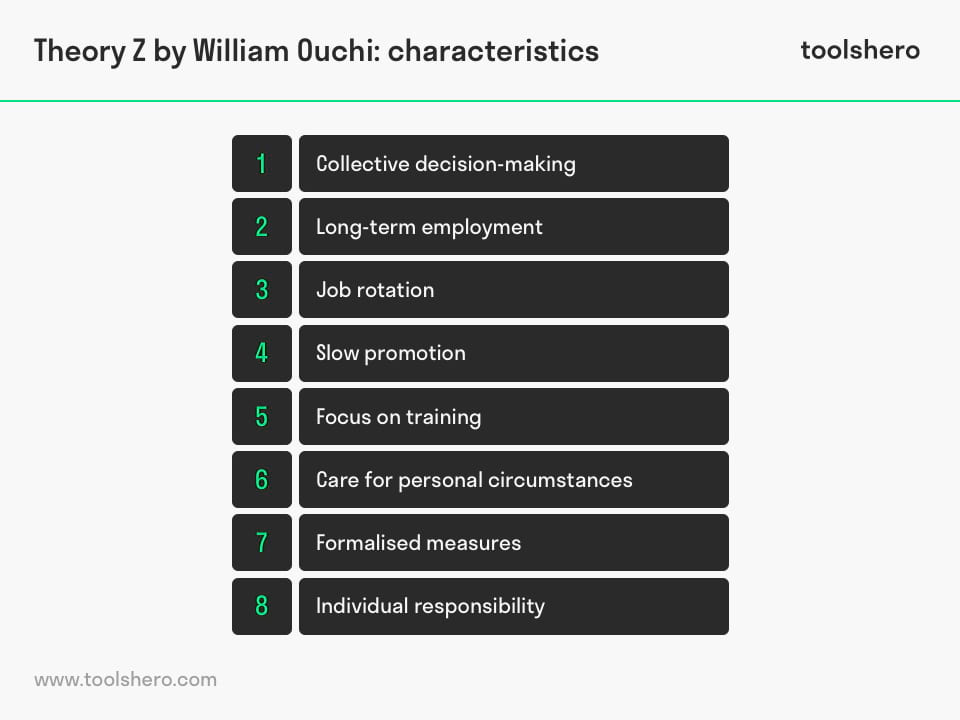
Actin thin filaments combined with myosin thick filaments conduct cellular movements. For Ouchi Theory Z focused on increasing employee loyalty to the company by providing a job for life with a strong focus on the well-being of the employee both on and off the job. William Ouchi developed Theory Z also called the Japanese management style that features a combination of the other styles.
Theory Z suggests that large complex organisations are human systems and their effectiveness depends on the quality of humanism used. William Ouchi developed Theory Z after making a comparative study of Japanese and American management practices. Developed by William Ouchi it emphasises a strong company philosophy a distinct corporate culture long-range development and employment consensual decision-making and moderately specialised career paths Adeniyi 2007.
Taylor believed employees were only motivated by one thing money. Theory Z style of management does not reflect US. How American management can Meet the Japanese.
The benefits of Theory Z Ouchi claimed would be reduced employee turnover increased commitment improved morale and. Theory Z was first identified as a unique management approach by William Ouchi. Theory Z is an integrated model of motivation.

Theories Of Management Theory Z Theories Public Relations Leadership

Theory Z By William Ouchi Toolshero
Theory Z By William Ouchi Toolshero
No comments for "Theory Z Was First Described by"
Post a Comment